AI image generation has moved from novelty to utility faster than almost anyone predicted. Designers use it for mood boards and concept exploration. Marketers generate social media visuals and ad variations. Developers create placeholder assets and UI mockups. And yes, people still use it to generate pictures of cats wearing medieval armor — but the professional applications are now the main event.
The three dominant platforms each take a radically different approach, and the best choice depends entirely on what you're trying to do.
The Quick Comparison
Midjourney produces the most aesthetically pleasing images with minimal effort. It excels at artistic, stylized, and photorealistic outputs and requires the least prompt engineering skill.
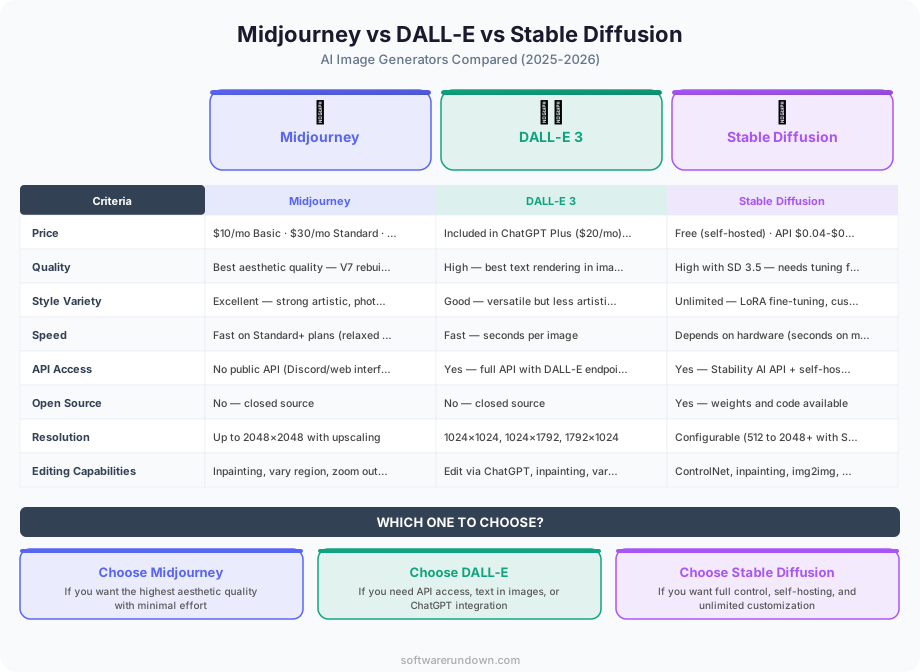
DALL-E 3 (via ChatGPT or the API) offers the best text understanding and instruction following. It's the most accessible option and handles complex, multi-element prompts better than competitors.
Stable Diffusion is open-source and runs locally, offering unlimited generation, maximum control through fine-tuning and community models, but requires technical setup and more prompt engineering expertise.
Midjourney
Midjourney has earned its reputation for producing strikingly beautiful images. The v6 model (released late 2024) and subsequent updates have pushed the quality bar even higher, with improved coherence, better hands (yes, AI hands used to be a meme), and remarkable photorealism when requested.
Quality and Style
Midjourney's default aesthetic is distinctly "cinematic." Images tend to have dramatic lighting, rich colors, and an editorial quality that makes them look like they belong in a magazine. This built-in style is both a strength (outputs look great with minimal effort) and a limitation (achieving a flat, minimalist, or deliberately rough style requires more work).
Photorealism is exceptional. Midjourney v6 generates images that are genuinely difficult to distinguish from photographs in many scenarios — portraits, landscapes, architectural photography, and product shots are all convincing.
Text rendering, historically a weakness, has improved significantly. Simple text (a few words on a sign or product label) renders correctly most of the time. Complex text layouts still require multiple attempts.
Interface and Workflow
Midjourney originally operated exclusively through Discord, which was charming for early adopters and frustrating for everyone else. The web interface (alpha.midjourney.com) now provides a more traditional experience with a prompt box, image gallery, and editing tools.
The workflow is prompt-based: you type a description, Midjourney generates four variations, and you upscale or create variations of the ones you like. Parameters like --ar 16:9 (aspect ratio), --style raw (less stylized), and --chaos 50 (more variation) give you control without complex syntax.
Pricing
Basic: $10/month (200 generations). Standard: $30/month (unlimited relaxed, 15 hours fast). Pro: $60/month (30 hours fast). Mega: $120/month (60 hours fast). No free tier — you must subscribe to use Midjourney.
Limitations
No API access for most plans (Pro and above get basic API). No local execution — all generation happens on Midjourney's servers. Limited inpainting and editing compared to Stable Diffusion workflows. No fine-tuning on custom datasets (a feature called "style references" provides partial workaround).
DALL-E 3
OpenAI's DALL-E 3 is integrated directly into ChatGPT, making it the most accessible AI image generator. You describe what you want in natural language — no prompt engineering needed — and ChatGPT interprets your request and generates the image.
Quality and Style
DALL-E 3's image quality is very good but typically a step below Midjourney's artistic polish. Where DALL-E 3 excels is in following complex instructions precisely. A prompt like "a red bicycle leaning against a blue fence with a yellow cat sitting on the seat and a white bird perched on the handlebars" is more likely to produce exactly that composition in DALL-E 3 than in Midjourney.
The style range is broad — DALL-E 3 can produce illustrations, 3D renders, photorealistic images, watercolor styles, and more. The results are clean and versatile, if sometimes a bit "flat" compared to Midjourney's more dramatic outputs.
Text rendering is the best of the three. DALL-E 3 handles text in images more reliably than Midjourney or Stable Diffusion, making it the best choice for images that include signage, labels, or typography.
Interface and Workflow
The primary interface is ChatGPT. You have a conversation: "Generate a hero image for a blog post about cloud computing, showing a futuristic server room with blue lighting, 16:9 aspect ratio." ChatGPT refines your prompt behind the scenes and generates the image. You can iterate conversationally: "Make the lighting warmer and add more depth of field."
This conversational approach is extremely beginner-friendly. You don't need to learn prompt syntax or parameters — you just describe what you want. The API is available for programmatic access, supporting integration into applications and workflows. Check our best AI tools 2026 roundup for how DALL-E fits into the broader ecosystem.
Pricing
Included with ChatGPT Plus ($20/month, with generation limits). ChatGPT Team ($25/user/month) and Enterprise (custom pricing) offer higher limits. API pricing: $0.04-0.12 per image depending on resolution and quality.
Limitations
Generation limits on ChatGPT plans (the exact number varies and isn't publicly specified, but expect 40-80 images per day on Plus). Content policy is the most restrictive of the three — DALL-E refuses many prompts involving real people, violence, and other sensitive categories. No local execution. No fine-tuning.
Stable Diffusion
Stable Diffusion is the open-source alternative developed by Stability AI. Unlike Midjourney and DALL-E, you can download the model weights and run them on your own hardware. This fundamental difference shapes everything about the platform.
Quality and Style
The base Stable Diffusion model (SDXL, SD 3.5) produces decent images, but the real magic is in the community ecosystem. Thousands of fine-tuned models, trained on specific styles and subjects, are available on platforms like Civitai and Hugging Face. Want photorealistic portraits? There's a model for that. Anime? Dozens of options. Architectural visualization? Product photography? Pixel art? All covered.
LoRA models (lightweight fine-tuned adapters) let you add specific styles, characters, or concepts to a base model without full retraining. ControlNet enables precise structural control using reference images, depth maps, or pose skeletons. These tools give Stable Diffusion a level of creative control that neither Midjourney nor DALL-E can match.
The trade-off is that achieving great results requires more knowledge. The base model out of the box produces competent but not exceptional images. The quality ceiling is higher than any competitor — but so is the skill floor.
Interface and Workflow
There's no single interface. The most popular options are:
AUTOMATIC1111 (Stable Diffusion WebUI): The established community interface with maximum features. Complex but powerful, with extensive extension support.
ComfyUI: A node-based interface that lets you build custom generation workflows visually. More flexible than AUTOMATIC1111 but with a steeper learning curve. Increasingly the preferred choice for advanced users.
Fooocus: A simplified interface inspired by Midjourney's ease of use, designed to produce good results with minimal configuration.
Cloud services: RunPod, Replicate, and others let you run Stable Diffusion in the cloud if you don't have suitable local hardware.
Pricing
The model is free and open-source. Running it locally requires a GPU with at least 6GB VRAM (8-12GB recommended). An NVIDIA RTX 3060 or better handles SDXL comfortably. Cloud GPU services charge $0.20-1.00/hour depending on the instance.
The practical cost is highly variable: free if you already have a capable GPU, or equivalent to a few dollars per month of electricity. For volume users generating hundreds or thousands of images, Stable Diffusion is dramatically cheaper than Midjourney or DALL-E.
Limitations
Requires technical setup (Python environment, GPU drivers, model downloads). Results are inconsistent without prompt engineering skill and model selection knowledge. No official support — community forums are your resource. Ethical and legal considerations around fine-tuned models vary.
Head-to-Head: Practical Scenarios
Marketing Social Media Graphics
Winner: Midjourney. The consistently high aesthetic quality and minimal effort required make it ideal for teams generating social media visuals regularly. The results look polished without post-processing.
Blog and Article Hero Images
Winner: DALL-E 3. The conversational interface makes it fast to generate specific concepts that match article topics. The ability to iterate through conversation ("more professional, less abstract") is more efficient than regenerating with modified parameters.
Product Mockups and Visualizations
Winner: Stable Diffusion. ControlNet's ability to use reference images for precise composition, combined with specialized models for product photography, produces the most controllable results.
Brand-Consistent Content
Winner: Stable Diffusion. Fine-tuning a model on your brand's visual style (or using LoRAs) ensures consistent aesthetic across all generated images. Neither Midjourney nor DALL-E offers this level of style customization.
Team with No Technical Expertise
Winner: DALL-E 3. The ChatGPT interface requires zero learning curve. Anyone who can write a sentence can generate an image.
Ethical and Legal Considerations
AI image generation raises important questions that responsible users should consider:
Training data: All three platforms trained on datasets that include copyrighted images scraped from the internet. This has led to lawsuits (ongoing as of 2026) and ethical debates. Stable Diffusion's open-source nature makes the issue more visible, but it applies equally to Midjourney and DALL-E.
Commercial usage: Midjourney and DALL-E allow commercial use of generated images on paid plans. Stable Diffusion's open-source license allows commercial use, but fine-tuned models may have additional restrictions. Always check the specific license terms.
Disclosure: Increasingly, platforms and regulations require disclosure when images are AI-generated, especially in advertising and editorial contexts. Midjourney and DALL-E embed metadata in generated images; Stable Diffusion does not by default.
Deepfakes and misuse: All three platforms can generate realistic images of scenarios that never happened. DALL-E has the strictest content policies. Midjourney is moderately restrictive. Stable Diffusion, being locally executed, has no content restrictions — which enables both legitimate creative freedom and potential misuse.
The Verdict
Choose Midjourney if you want consistently beautiful images with minimal effort, primarily for creative and marketing purposes.
Choose DALL-E 3 if you want the easiest possible workflow, excellent instruction following, and integration with ChatGPT for iterative refinement. It's also the best choice for teams where not everyone is technically oriented.
Choose Stable Diffusion if you want maximum control, unlimited generation, local execution (data privacy), or need to fine-tune models for specific styles or brands. Be prepared to invest time in learning the ecosystem.
Many professionals use two or even all three depending on the task. There's no rule that says you must pick one — and the landscape continues to evolve rapidly. What's true today may shift in six months as each platform releases new models and features.