AWS vs Azure vs Google Cloud at a Glance
Picking a cloud provider in 2026 is one of the most consequential infrastructure decisions a company can make. The three hyperscalers — Amazon Web Services, Microsoft Azure, and Google Cloud Platform — collectively control roughly 65% of global cloud spend, yet they serve very different needs, cultures, and budgets. Before diving into the details, here is the fast-comparison table every decision-maker deserves to see in the first two minutes.
| Criteria | AWS | Azure | Google Cloud |
|---|---|---|---|
| Market Share (2025) | ~31% | ~25% | ~12% |
| Pricing Model | Pay-as-you-go + Savings Plans | Pay-as-you-go + Hybrid Benefit | Pay-as-you-go + Committed Use |
| AI / ML Services | SageMaker, Bedrock | Azure OpenAI, Copilot Studio | Vertex AI, Gemini API |
| Global Network | 33 regions, 105 AZs | 60+ regions worldwide | 40 regions, private backbone |
| Support Plans | Basic (free) → Enterprise | Basic (free) → Unified | Basic (free) → Premium |
| Free Tier | Always-free + 12-month | Always-free + 12-month | Always-free (generous compute) |
| Ease of Use | Steep learning curve | Familiar for Microsoft shops | Clean UI, strong docs |
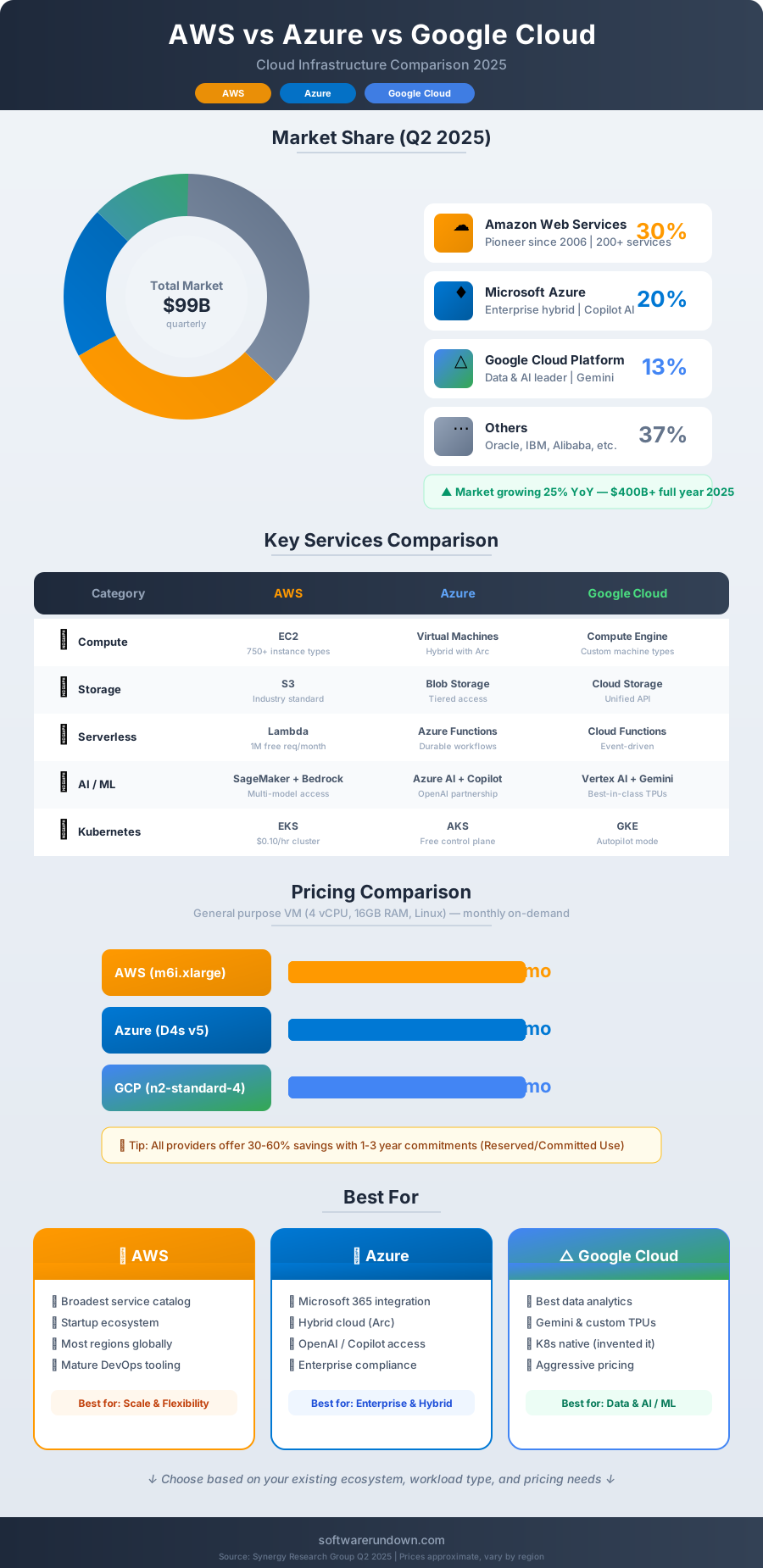
That table tells part of the story. The rest — cost traps, AI capabilities, compliance postures, and real-world performance — is where the providers truly diverge. Read on for the full breakdown, or jump directly to the Cloud Computing Guide 2026 for the broader strategic picture.
Market Share and Momentum in 2026
AWS is still the incumbent king. Launched in 2006, it has a two-decade head start and an ecosystem so wide it borders on overwhelming — over 200 fully managed services, a partner network of tens of thousands, and a default position in most startup architecture conversations. Its revenue continues to grow in the high teens year-over-year, though its percentage share is being chipped away steadily.
Azure's rise is the enterprise story of the decade. Microsoft's tight integration with Active Directory, Office 365, and Teams means that any organisation already living in the Microsoft stack faces near-zero friction when moving workloads to Azure. The Azure Hybrid Benefit — which lets enterprises reuse existing Windows Server and SQL Server licences — has been a decisive factor for migration projects that would otherwise look expensive on paper.
Google Cloud is the fastest-growing of the three in percentage terms, crossing $40 billion in annualised run rate in late 2025. Its competitive advantages are clear: best-in-class networking (the same private fibre backbone that powers Search and YouTube), the most advanced AI research pipeline (DeepMind, Gemini, TPU hardware), and pricing that tends to undercut AWS on compute for equivalent specs.
Pricing: Where the Real Differences Hide
All three providers use a consumption-based model, but the details matter enormously at scale.
AWS Pricing
AWS pricing is famously granular — and famously confusing. On-Demand rates are the highest of the three, but Savings Plans (compute or EC2-specific) and Reserved Instances can cut bills by 30–72% over one or three years. Spot Instances remain the best option for fault-tolerant batch workloads, offering up to 90% discounts with the caveat of potential interruption. Data egress is a persistent pain point: moving data out of AWS costs between $0.09 and $0.05 per GB depending on volume, a tax that locks many customers in once they have significant stored data.
Azure Pricing
Azure's headline advantage is the Hybrid Benefit — worth scrutinising carefully if your organisation has Software Assurance coverage. On like-for-like compute, Azure and AWS are within 5–10% of each other at list price. Where Azure surprises on the upside is its Dev/Test pricing for non-production environments, which strips out Windows licence costs and can halve the bill for development workloads. Like AWS, egress fees exist and accumulate quickly in multi-cloud architectures.
Google Cloud Pricing
Google Cloud offers Sustained Use Discounts automatically — no upfront commitment required. If a VM runs more than 25% of a month, discounts kick in progressively, reaching up to 30% for full-month usage. Committed Use Contracts (1 or 3 years) can push discounts to 57%. Notably, Google eliminated most network egress fees within the same continent in 2024, a move that directly attacks the lock-in strategy its competitors rely on. For teams building data pipelines between storage and compute, this alone can justify a migration. For a detailed cost breakdown by use case, see our guide on cloud hosting costs in 2026.
AI and Machine Learning: The Battleground of 2026
If cloud computing was defined by virtual machines in 2010 and containers in 2018, it is defined by AI infrastructure in 2026. All three providers have made enormous bets here, but from very different angles.
AWS: Bedrock and the Partner Ecosystem
Amazon Bedrock gives developers API access to a curated set of foundation models — Anthropic Claude, Meta Llama, Mistral, Cohere, and Amazon's own Nova family — without managing the underlying infrastructure. SageMaker remains the workhorse for teams training and fine-tuning their own models, offering managed notebooks, pipelines, and endpoints. AWS's AI play is less about owning the frontier model and more about being the neutral marketplace where enterprises can pick and deploy whichever model fits their governance requirements.
Azure: The OpenAI Partnership Pays Off
Microsoft's investment in OpenAI has translated directly into Azure's most powerful differentiator. Azure OpenAI Service provides enterprise-grade access to GPT-4o, o3, and DALL-E 3 with data residency guarantees, private networking, and compliance controls that raw OpenAI API calls cannot match. Copilot Studio allows non-engineers to build AI agents on top of enterprise data with a low-code interface. For organisations already using Microsoft 365, the integration path is genuinely frictionless. The risk: over-dependency on a single AI vendor in a market that is moving fast.
Google Cloud: Vertex AI and Native Gemini Access
Google's position is arguably the strongest on raw AI capability. Vertex AI is a unified ML platform covering data labelling, training, evaluation, and deployment. The Gemini API gives developers direct access to Google's frontier model family, and custom TPU pods are available for teams training at a scale where GPU costs become prohibitive. For companies building AI-native products — rather than bolting AI onto existing software — Google Cloud's infrastructure is hard to beat. This overlaps directly with tools we covered in our roundup of the best AI tools in 2026.
Global Network and Reliability
AWS operates 33 geographic regions composed of 105 Availability Zones as of early 2026, with new regions in Malaysia, Thailand, and New Zealand in various stages of launch. Its CloudFront CDN spans 600+ edge locations globally. The sheer density of the network means that for most enterprise use cases, AWS can offer sub-10ms latency to end users almost anywhere in the industrialised world.
Azure's 60+ regions make it the widest footprint of the three by region count, a meaningful advantage for multinational enterprises with data sovereignty requirements. The ExpressRoute private connectivity product integrates cleanly with on-premises data centres, which is a recurring theme in Azure's enterprise pitch.
Google Cloud's network is physically distinct from its competitors because it runs on the same private fibre infrastructure that Google built for its own products over two decades. Data travelling between Google Cloud regions or between a user and a Cloud CDN edge node often never touches the public internet, which reduces latency variability. For latency-sensitive applications — financial trading systems, real-time gaming backends, live video — this private backbone is a genuine technical edge.
Security and Compliance
All three providers hold the full roster of enterprise compliance certifications: ISO 27001, SOC 2 Type II, PCI DSS, HIPAA, FedRAMP (US government workloads), and GDPR-aligned data processing agreements. The differences are in tooling and philosophy.
AWS Security Hub aggregates findings from GuardDuty, Inspector, Macie, and third-party tools into a unified posture dashboard. The breadth is impressive; the complexity can be overwhelming for teams without a dedicated cloud security engineer. Azure Defender for Cloud (formerly Security Center) benefits from deep integration with Entra ID and Sentinel SIEM, making it the natural choice for organisations whose threat model is centred on identity. Google Cloud Security Command Center is newer but has matured rapidly, with Mandiant threat intelligence now baked in following Google's acquisition.
Developer Experience and Ecosystem
Developer experience is subjective, but some patterns hold across thousands of engineering team surveys.
AWS has the largest community, the most Stack Overflow answers, and the highest number of third-party integrations. The console is notoriously cluttered — it was designed to surface options rather than guide workflows — but tooling like AWS CDK and the renewed focus on the Console-to-Code feature (which generates infrastructure-as-code from console clicks) is improving the experience. If a service exists somewhere in the cloud landscape, there is almost certainly an AWS equivalent or integration.
Azure's developer experience is strongest for teams in the .NET and Windows ecosystem. Visual Studio and VS Code integrations are first-class. Azure DevOps is a mature CI/CD platform that competes directly with GitHub Actions (which Microsoft also owns, creating a somewhat recursive product landscape). Teams outside the Microsoft orbit sometimes find the product naming conventions confusing — Azure has renamed and consolidated services several times, leaving documentation in various states of currency.
Google Cloud's developer experience has improved significantly since the platform invested in its developer relations program. Cloud Shell is genuinely excellent. The documentation is well-maintained, and products tend to follow the Unix philosophy of doing one thing well rather than growing into monolithic feature sets. The main complaint historically has been product discontinuation risk — Google's track record of killing services has made some engineering teams hesitant to build core infrastructure on GCP products with smaller adoption footprints.
Which Provider Should You Choose in 2026?
There is no universal answer, but the decision tree simplifies quickly once you ask three questions.
Are you a Microsoft-heavy enterprise? Azure is almost certainly your lowest-friction path. The licensing economics, the Active Directory integration, and the Copilot AI layer inside the tools your teams already use every day create a network effect that is hard to replicate.
Are you building an AI-native product or training large models? Google Cloud deserves serious evaluation. Vertex AI, native Gemini access, TPU availability, and the best raw networking infrastructure give you advantages that compound over time. Add in the sustained use discounts and eliminated egress fees, and the cost story is compelling.
Do you need maximum service breadth, global ecosystem, or are you a startup following the path of least resistance? AWS remains the default. Its ecosystem, talent availability, and service depth are unmatched. Hiring is easier because more engineers know it. Third-party SaaS integrations default to AWS first. Its maturity creates stability.
Multi-cloud architectures — running workloads across two or all three providers — are increasingly common for large enterprises managing regulatory requirements or avoiding single-provider lock-in, but they add operational complexity that smaller teams rarely have the capacity to absorb. Start with one provider, master it, and expand only when a specific capability gap justifies the overhead.
The Bottom Line
AWS leads on ecosystem breadth and market maturity. Azure leads on enterprise Microsoft integration and identity-centric security. Google Cloud leads on AI infrastructure, networking performance, and pricing transparency. In 2026, none of them is a bad choice — but matching the provider to your actual workload, team composition, and strategic roadmap will determine whether your cloud bill feels like an investment or a penalty.